
By Carmel O’Callaghan and Cyndie Goodall
‘Begin with an area of grammar you feel confident with and do it in manageable chunks with consideration given to how you might sequence the activities.’
Having taken the 3: Language and Literacy for Learning course, we were keen to try applying our new knowledge. We based our approach on the above quote. We were interested in how to teach processes to primary students and, in particular, how learning about mental processes could improve their narrative writing.
This reading describes an action research project in an international school in London and the sequence of the activities we used to teach these processes. It involved two groups of 8- to 9-year-old boys and girls with varying academic abilities.
Before we started our instruction of processes, we gave Group A, which consisted of five students, a picture story to write about. They had learnt about action processes the previous year when studying procedures, but had no instruction in the four main process groups. For the purpose of comparison, we gave all the students the same picture story. The students were asked to write a story based on a sequence of four pictures showing some pixies finding a giant’s button and returning it to him.
Four out of the five students in Group A produced a text similar to the following samples, using only one or two mental processes.
The little people found a button. They didn’t now what to do with it. They looked around. Then they looked up. Giant drops wer falling. It was a big person. It was his button. The little people roled it to him. The big person picked them up and the buton. He was happy. The little people helped him sew it on. (Danielle, aged 8)
The pixes found a button on the ground. The pixes doun’t now what is it, and they try to figer what it is. So the pixes pick up the butten and then they find more tear drops. So they role the button. They find more tear drops and a big shoe. And then they sow the butten. And give it to the giant. So the giant crise. (James, aged 9)
We then took a second group of five students, Group B. We taught them about the four major types of processes and did a series of activities to help them understand the use of mental processes in narratives.
At the end of the period of instruction, we planned to give them the same sequence of pictures as Group A. We wanted to see if they would use more mental processes and therefore improve their writing. To clarify the concept of mental processes, we initially used the term ‘thinking and feeling’ processes.
Introducing the four process groups
We undertook a number of activities to teach mental processes. We started by explaining and giving examples of the four process groups. We used the term ‘verb’ and ‘process’ group interchangeably because the general school population was more familiar with the term ‘verb’. We went from the most concrete process group (action) to the least concrete group (relational).
Starting with action processes, we used picture cards as examples and had students act them out and try to guess each other’s action.
Next, we moved on to saying processes. After giving a few examples, we brainstormed a list with the students. They chose a saying process card from a hat and then acted out the word.
As an introduction to mental processes we deconstructed a text that contained many examples. Beverly Derewianka (2022) recommended using a passage from Lewis Carroll’s Through the looking glass.
“I wish the monstrous crow would come!” thought Alice.
“There’s only one sword, you know, Tweedledum said to his brother: “but you can have the umbrella—it’s quite as sharp. Only we must begin quick. It’s getting as dark as it can.”…
It was getting dark so suddenly that Alice thought there must be a thunderstorm coming on. “What a thick black cloud that is!” she said. “And how fast it comes! Why I do believe it’s got wings! …
Alice ran a little way into the wood, and stopped under a large tree. “It can never get me here,” she thought … “But I wish it wouldn’t flap its wings so …”
By this time it was getting light. “The crow must have flown away, I think,” said Alice. “I’m so glad it’s gone.
I thought it was the night coming on.”
“I wish I could manage to be that glad!” the Queen said. “Only I can never remember the rule. You must be very happy, living in this wood, and being glad whenever you like!”
We put this text on the interactive whiteboard for the group to see. We read the whole text to them and then read it sentence by sentence. After giving some examples from the text, we had the students finish identifying the mental processes. We highlighted these in green. We discussed how these processes revealed what the character was thinking and feeling. They also gave the students a greater understanding of the characters’ motivations (why they act the way they do), by knowing their thoughts and wishes. We asked the students questions like:
Teacher: ‘Why did Alice run into the woods?’
Thomas (aged 8): ‘She didn’t think the crow could get her in there.’
Teacher: ‘That’s right.
Thomas. We know why she ran because we know what she was thinking.’
Teacher: ‘How did the Queen feel about Alice?’
Erik (aged 8): ‘The Queen wished she could be glad whenever she wanted to, like Alice.’
Teacher: ‘Yes, the text told us what the Queen wished for.’
We pointed out to the students that mental processes are found mostly in narrative texts and not often used in factual genres. When we subsequently taught information reports, we made a comparison between the processes in an information report and in a narrative. We again highlighted the fact that a good information report doesn’t include phrases such as ‘I like’ or ‘I wish’.
Once the students knew the three process groups—action, saying and mental—and after a brief explanation of each group, we used three green boxes of words and pictures to help the students organise the three process groups they were familiar with. The picture below shows the three boxes we started with plus the additional ‘relational process’ box added later.
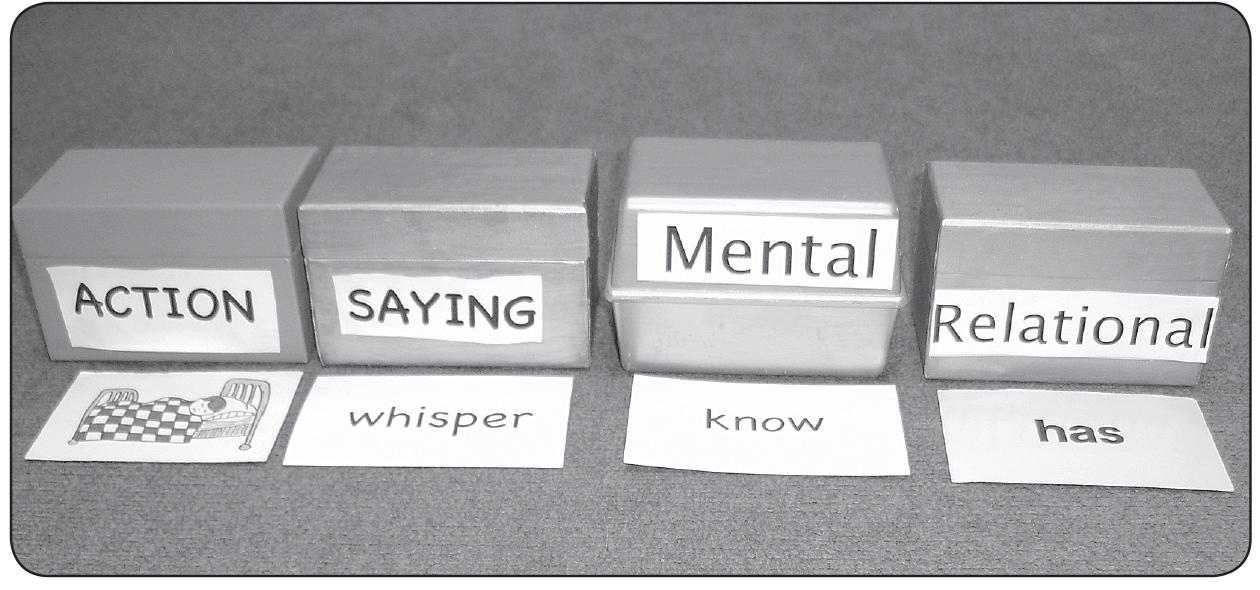
After sorting the three process groups that we had introduced, we looked at the box that was left. This contained the relational processes. We explained that these processes link two pieces of information. We then asked the students to write some sentences about lions using some of the relational process cards and some action process cards.
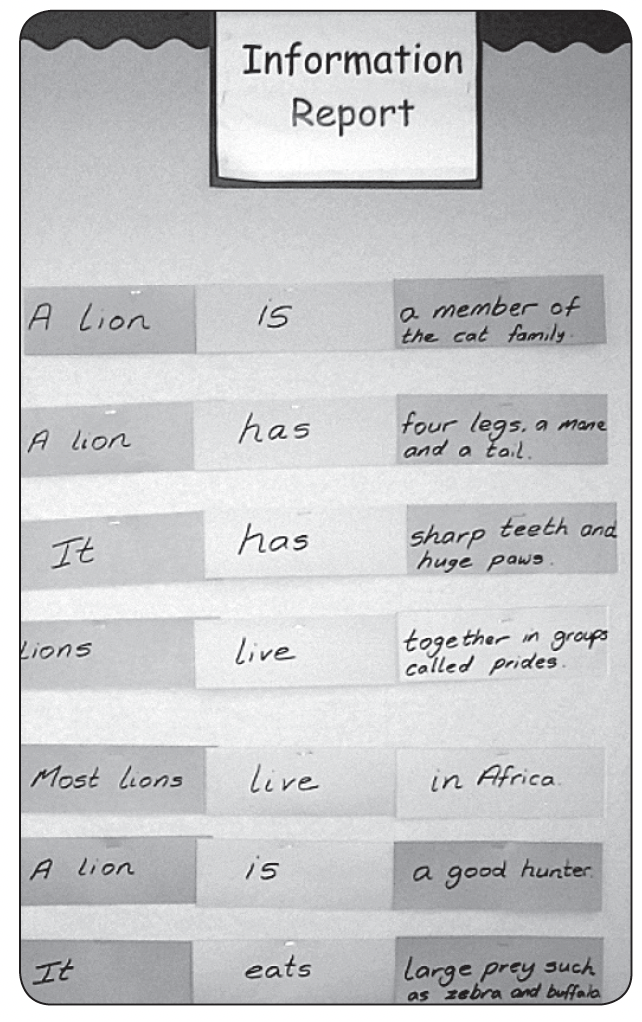
We colour coded these sentences and highlighted the processes in green. They were then identified as an action process or a relational process. The students identified the pieces of information that were linked by the relational processes.
Then we brainstormed additional examples of each process group with the students. We provided an ongoing word wall that could be added to as they found more examples in their reading and writing.
Next, we labelled the corners of the room with the four process groups and gave a flashcard to each student with a picture or word written on it. Their task was to go to the corner that matched their card. For example, if the student was given a card with ‘whisper’ on it, the student would go to the ‘saying’ corner.
We then assessed the students to see if they had internalised the process groups by having them individually sort the cards into the correct groups. We gave them a stack of green cards to classify.
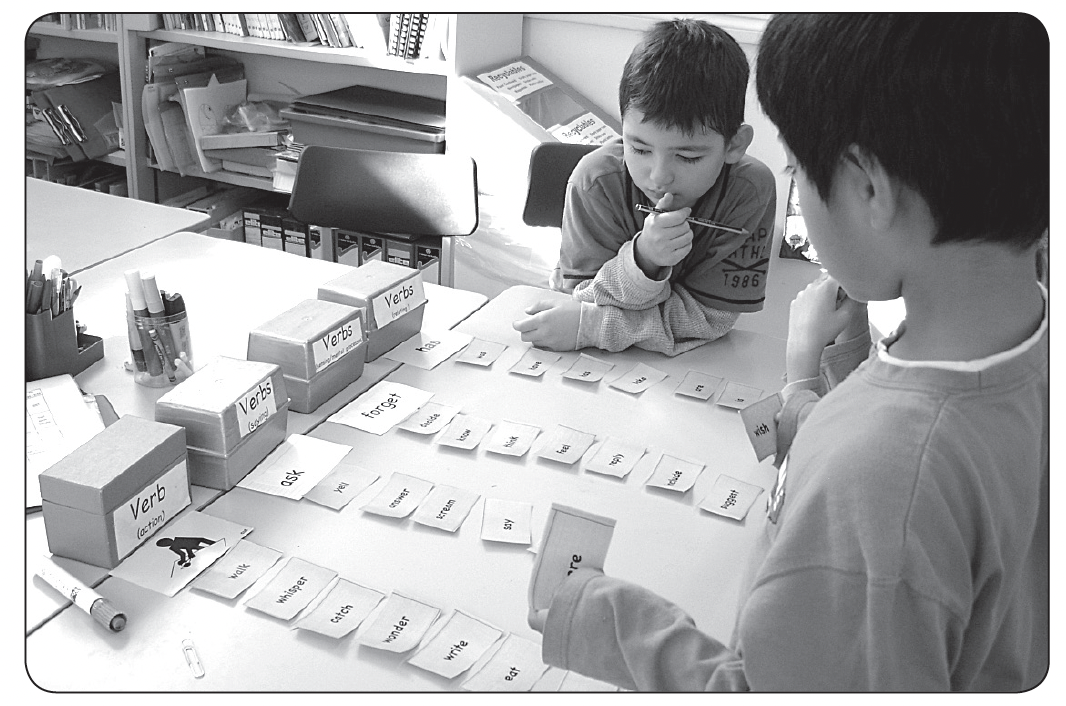
Once the students were familiar with the four main groups, we did additional sorting exercises to highlight the past tense forms of the action and mental process groups. We put a word bank of present and past tense mental processes on the wall for future reference.
Adding mental processes to a text
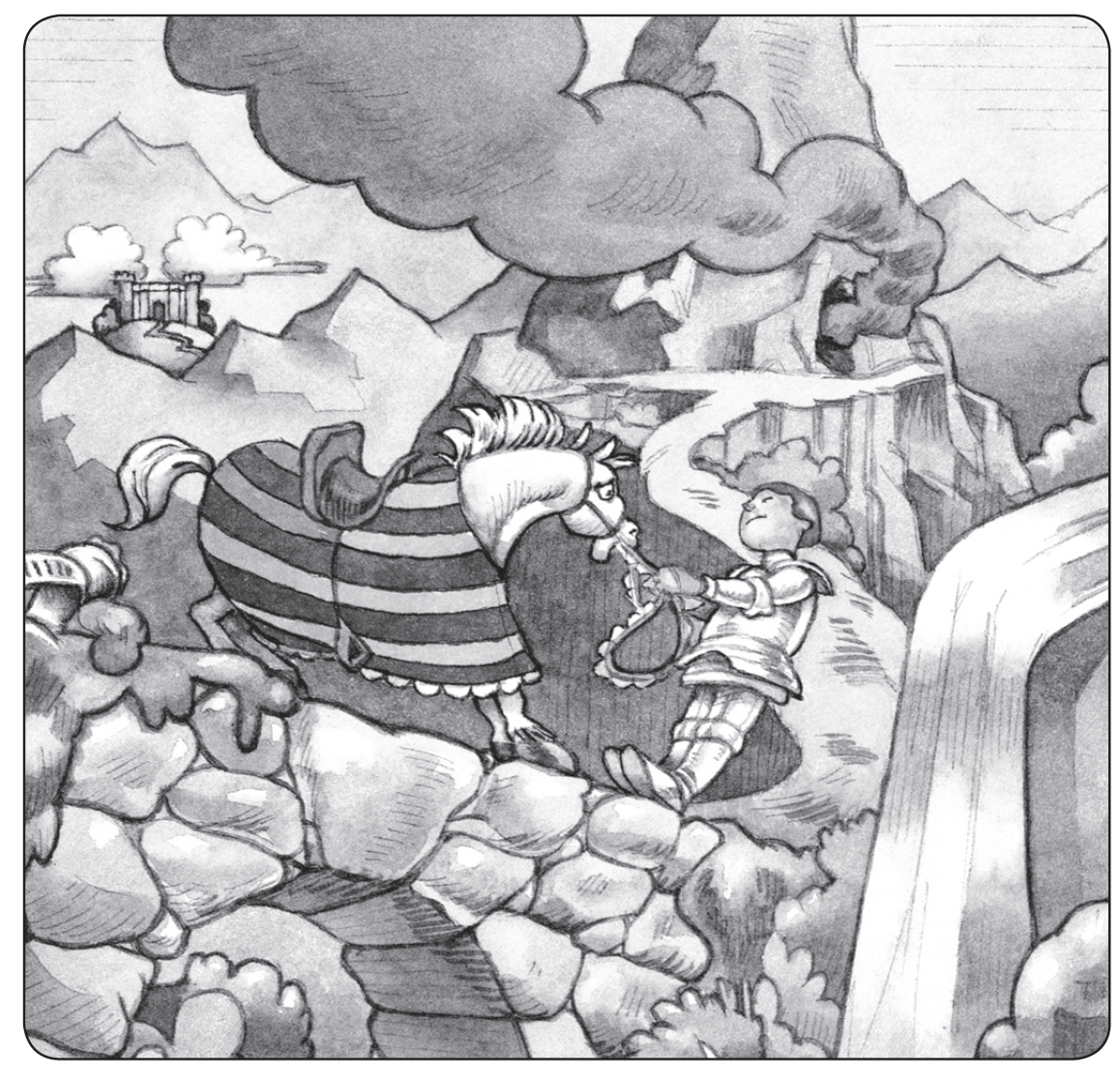
We started this lesson by showing students a picture of a knight trying to pull his horse towards a dark cave that had smoke billowing out of it (Figure 4).
On one side of the picture, we wrote:
‘The knight tried to pull the horse up the mountain, but he wouldn’t move.’
Then we discussed what kind of processes were used in this description. The students discovered that there were some action processes. We then asked if it contained any mental processes that revealed how the characters were feeling or what they were thinking. There were none. We told the students that we were going to look at the same story and see how mental processes could give human characteristics to animal characters.
We then looked at a second version of the same story:
On the way up the mountain the horse decided that he didn’t want to meet the dragon. He imagined that the dragon would want to eat him and he felt terrified. The knight tried to pull him up the mountain but the horse wouldn’t move.
We discussed how the mental processes in this text helped us to understand how the horse felt and why he didn’t want to go up the mountain. These mental processes helped to create empathy for the horse and revealed the horse’s point of view. It also provided the opportunity to talk about how mental processes could give human characteristics to animal characters in students’ stories.
Another activity we used to help students become more aware of mental processes was a drama technique called ‘hotseating’. This is a technique used in drama to deepen an actor’s understanding of a role. The actor sits in the hotseat and is asked questions by other members of the cast about certain aspects of the storyline in the play or what the actor’s relationship is with other characters. The actor answers as the character he/she is playing. In schooling, a student assumes the role of a character from a story he/she has read or heard and is used as a way of exploring characters’ feelings.
Our group listened to the story of Snow White. Then, one student was hotseated in front of the group (or it can be modelled by the teacher the first time). The person in the hotseat was interviewed by the rest of the group as if he/she was a character from the story (Snow White in this case). The group was encouraged to use teacher prepared question starters to interview ‘Snow White’. We used the following prompts:
- Why did you (decide, react, choose, like, dislike …) …?
- What do you think about …?
- How did you feel when …?
The hotseated student drew from a word bank of mental processes to answer these questions. This gave the students the opportunity to focus on how the character was feeling or thinking.
Some student questions and responses were:
Q: Why did you decide to live with the seven dwarfs?
A: I knew I couldn’t go back to my wicked step-mother.
Q: How did you feel when you saw the prince?
A: I thought I loved him.
Putting it into practice
Following these activities, we asked Group B to write the same ‘Pixy’ story as the control Group A (the students with no formal instruction in the process groups). Group B (the students with formal instruction) used an average of eight sensing processes in their stories. Below are two examples of their texts.
One day 4 pixys found a buton on the ground. They didn’t know what the buton was for. They wondered whose it was. They felt puzzled. A drop of water fell on the buton. They picked up the buton. Two raindrops came down on the buton. They wondered about where the drops came from. They felt sad. They rolled the button along the ground. They heard someone crying. They thought that was his button. They felt sorry for him. They wished they could help him. The giant picked up the buton and the pixies. The pixies shod the buton back on the giants short. The giant stopped crying. They felt proud of themselves. (Philip, aged 8)
One day four little dwarfs saw a big blue shiny wheel. They didn’t know what it was. So they decided to take it home. While they were lifting it up big drops fell on there heads. They wandered were it had come from. They started rolling what they now new was a button. They heard someone walking. They saw a big foot on the ground. They went straight to the foot. The giant picked up the button and the dwarfs. The giant felt very happy. The dwarfs were glad that the giant got back his button. Then they sawed the button back on the giants shirt. (Matilde, aged 9)
Conclusion
After explicit teaching, we were hoping to see an increased use of mental processes. However, our expectations were exceeded.
Although this was a small-scale research project, it did show an increased use of mental processes in the students’ writing after instruction. The students in group B used, on average, at least three times more mental processes in their writing than Group A. We were surprised at how many mental processes the students used and how much this improved their stories. We were very pleased with the results and it gave us the confidence to develop more activities for teaching mental processes.
The students themselves became more aware of how choosing mental processes could help to develop the characters in their stories. As a follow up to this, we asked the students to write their own narratives. Most of them reverted back to using predominantly action processes in their first draft. We used hotseating activities to help them revise their work with specific question prompts. The revised versions included many mental processes which helped to explain their characters’ feelings and motivations.
When the students were sharing their stories with their parents at student-led conferences, they were able to use a metalanguage to explain how they had improved their writing. For example, they said things like:
Using thinking and feeling verbs helped me to explain how the character was feeling and what he was thinking.
Here is where I used thinking and feeling verbs. They tell you what the dog is thinking and why he didn’t want to go home.
Teaching mental processes gave us a concrete way to help students improve their narrative writing. It gave a depth to the writing of many students that was previously apparent in only one or two students’ work.
Bibliography
Carroll L (2010) Alices’s adventures in Wonderland and Through the looking glass. Illustrated by Mervyn Peake. London, Bloomsbury.
Derewianka B (2022) A New Grammar Companion for Teachers (3rd Edition). Marrickville Metro, NSW, Primary English Teaching Association.
Silver, Burdett & Ginn (1990) ‘What’s cooking?’ In World of language. Illustrated by Fred Winkowski. Silver, Burdett & Ginn Inc.