We would like to thank Yeronga State High School for letting our team interview their staff on the successful implementation of Lexis Education’s Teaching in English in Multilingual Classrooms (TEMC) course within the school, and for sharing valuable internal documents.
Context
Yeronga State High School, an inner-city Brisbane public school with around 1,000 students from more than 70 countries, has long embraced cultural and linguistic diversity as being central to its identity. With over half of its students identified as English as an Additional Language or Dialect (EAL/D) learners, the school sought a consistent, evidence-based approach to supporting students’ learning by underpinning their pedagogy with a focus on language development across all subjects.
As EAL/D students with varied educational backgrounds entered mainstream classes, teachers needed the skills and confidence to teach the language tools explicitly across the curriculum. While Yeronga had a proud history of EAL/D support, leaders recognised the need for a unified approach that would empower every teacher to be a teacher of language, to understand how this would improve students’ learning.
The TEMC solution
Yeronga’s journey with Teaching in English in Multilingual Classrooms (TEMC) began 15 years ago, in 2010, with earlier versions of the TEMC course. Initially introduced to address the language gaps of newly-arrived refugee students, Principal Ben Orford  explains how the program has become a cornerstone of Yeronga’s professional learning framework and approach, explaining the decision to train every staff member and the evidence-based value it brings to a diverse student population:
TEMC has [had] a huge impact on our school. We’ve made a whole-school commitment to train every staff member. It’s about seeing the value of the strategies and the evidence that sits behind TEMC to support our student base, which we know is more than 50% EAL/D students.
Principal Orford reflects on the school’s deliberate investment of time and resources, noting that, despite the scale of the commitment, staff enthusiasm and the program’s proven effectiveness make it unquestionably worthwhile:
I think the feedback that we hear from our staff is really positive. I think it’s as well about finding that time in our calendar to commit to training our staff member. It’s a huge commitment from us but I think it’s one that we see has massive value. We know that by using TEMC, we’re doing best practice. I feel confident that we’re doing the best work that we can for our young people.
Orford highlights the importance of cultivating specialist capability within the school through Lexis Education’s train-the-trainer model, emphasising the desire to model best practice and ensure that the right expertise is consistently available to students:
Having that expertise in our school is really valuable. I think it’s really great for us to practise what we preach. We want to be an expert in that space, and we’re really keen to ensure that we have the right staff who do it.
Finally, he points to tangible improvements across the school, noting that student engagement and performance have reached their strongest levels yet.
Globally, in terms of our results across the school, we know that our students are engaging more than they ever have, they’re performing better than they ever have.
The implementation
Today, Yeronga’s EAL/D Coach Jacqi Bottger leads an ambitious, whole-school rollout of TEMC, ensuring almost every teacher completes the program within their first 12 months at the school: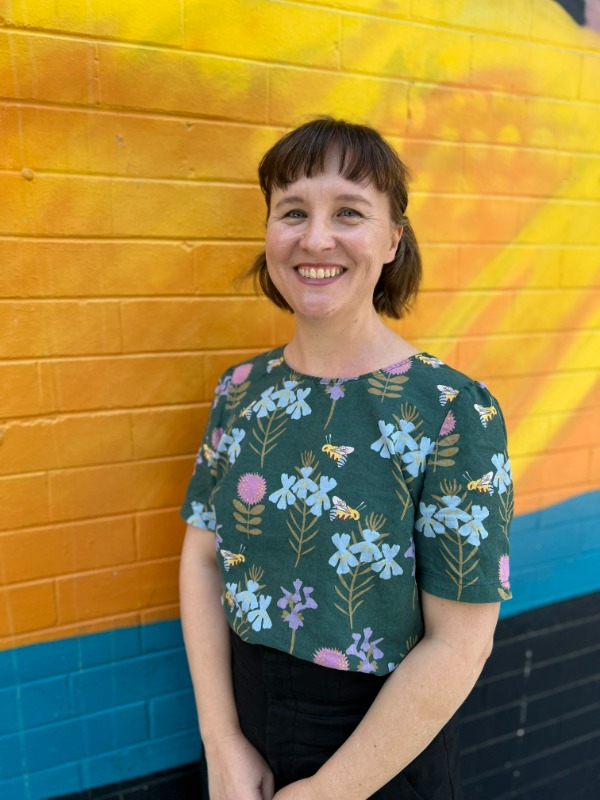
I campaigned for quite a while to become a tutor and eventually got to do that in 2020. It’s really useful to have an expert at the school. We’re aiming to upskill teachers at the school within their first 12 months. This year, we’ve run three rounds of the course.
The program runs intensively—five full days over a ten-week term—with around 5–10 teachers per cohort. Delivered on-site by an accredited tutor, the approach is cost-effective, contextually relevant and deeply embedded in Yeronga’s culture:
For our context, where we want all staff to be involved, having it on site and essentially free after that initial investment, makes it much more cost-effective than trying to send a bunch of people off-site to do a course. It then becomes our go-to PD (professional development). There’s one thing that everybody in the school has done of this scale, and that’s TEMC.
Download Yeronga’s TEMC sample schedule
Building a shared pedagogy
As Jacqi explains, TEMC has reshaped teacher mindsets at Yeronga, giving every teacher a shared understanding of their role in supporting language development:
For our school, I think it certainly gives all of our teachers across the school access to teaching language, which they might not have otherwise had, and the realisation that they are teachers of language, and that it, I suppose, sets up an expectation at our school that language will be incorporated into our lessons.
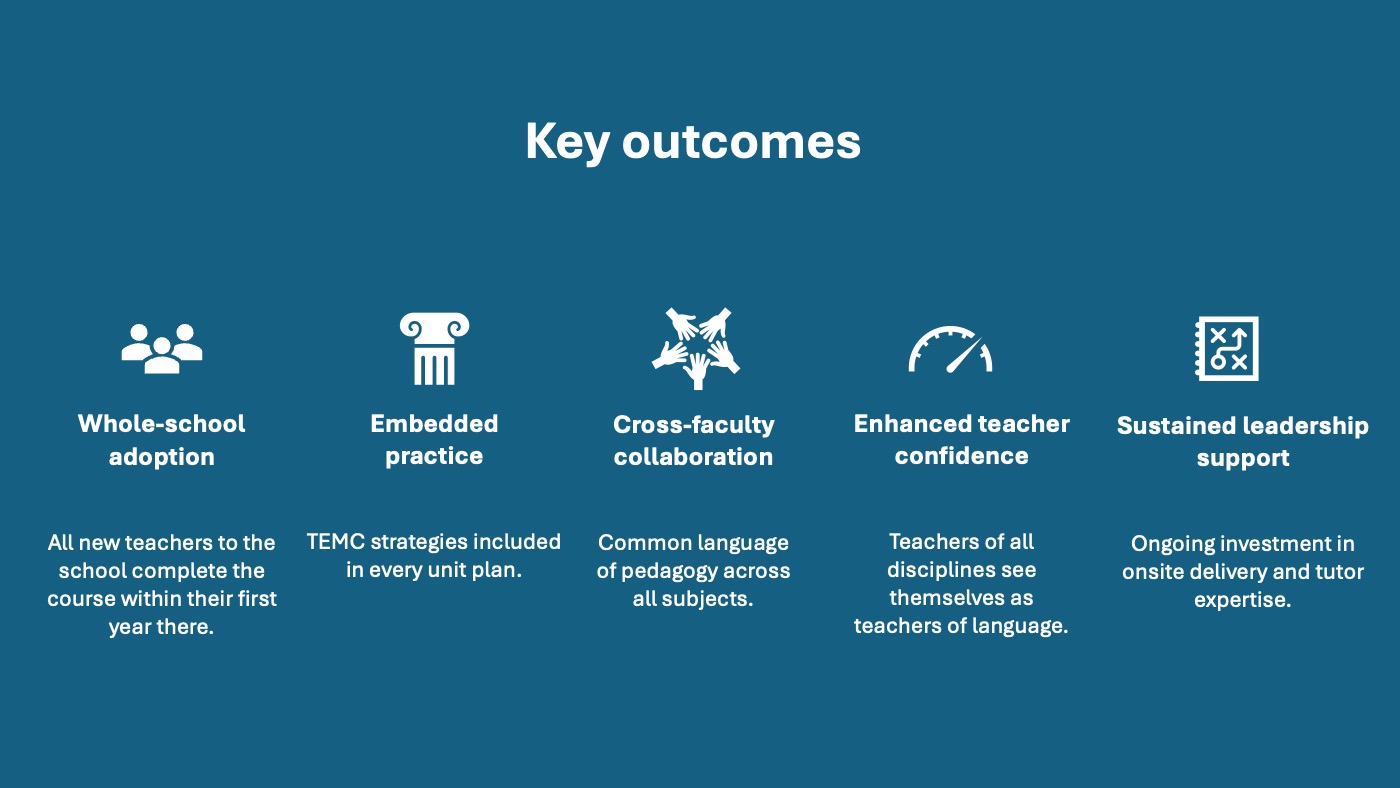
The impact is visible in the way teachers plan, collaborate and discuss teaching. Unit plans now include a dedicated ‘TEMC column’, linking explicit language strategies to each subject area:
I’m working with Head of Departments at the end of this year to identify three to five key strategies from TEMC for each subject – for example, dictogloss or passive & active voice in Year 7 Science. So that’s my goal for the end of this term – to sit down with the teachers and say, what are the language demands for this particular cohort and what do we need? That’s ahead of the game. Everybody benefits from it.
Download Yeronga’s language mapping within faculties
Teacher impact
Teachers describe TEMC as both transformative and practical. EAL/D teacher, Anne Evrat, found the course’s strategies immediately powerful in her classroom:
I really like the part of the course about nominal groups. I loved the way that you can see a pattern, and I went through a whole text picking out every nominal group, and I thought it was really great to show them the patterns. Then I saw a massive improvement in their ability to write.
Something else that I really liked was that idea of tracing words/phrases in a text that are all referring to the same thing [lexical strings] in all different colours and then showing them how they can vary their language. We had these chains going through this whole text in all different colours, one colour for each chain of meaning, and then, when you just read the chain, it’s actually very informing about language use, and it was showing them how to really raise their standard. Even though I’ve considered myself quite an experienced teacher, I found it really, really good.
Head of English and EAL/D, Petrina Zagami, agrees: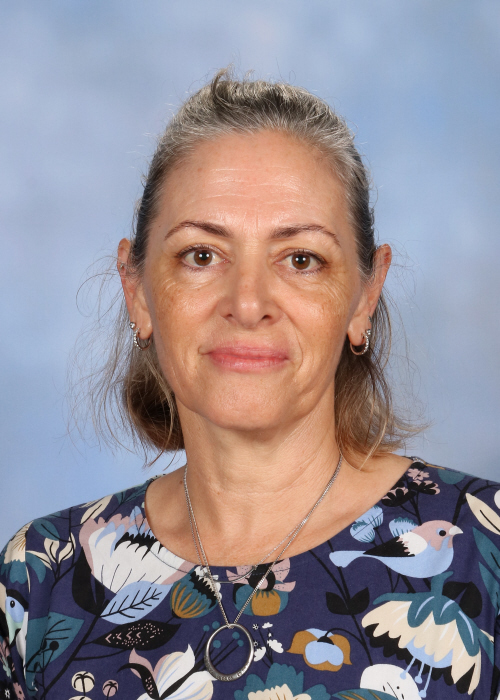
It was amazing. The first comment that I made, and I think a lot of what I hear teachers say about TEMC, is that it’s good teaching and practice.
I quite often do dictogloss activities to model an introduction for my senior EAL students. And they find it quite challenging, but it just removes that layer of going to AI and trying to do something or just building their language. That’s really powerful.
Zagami has seen renewed enthusiasm and collaboration among her staff:
I think a really beautiful example of that is one of our very experienced EAL/D teachers in the English faculty who is constantly mentoring another teacher who also is experienced but not necessarily experienced in teaching senior English. The amount of time that they are sitting in our kitchen and talking about an activity that they’re going to do, it’s just the two of them (…), it’s like they’ve come to life again and their whole teaching is reinvigorated. She keeps saying, ‘I’m just trying different things and I’m so excited.’
Jacqi Bottger and Holly Haswell-Smith, Head of Department Middle Secondary, co-delivered TEMC during the first semester of 2025. The feedback from their participants was outstanding (average score: 9.625 out of 10).
Participants consistently described the course as highly impactful, praising its intellectual challenge and practical hands-on learning. They felt they gained valuable knowledge they could confidently apply in their work.
This has been the most valuable PD around EALD I’ve ever done.
I was intellectually challenged at every stage – this made the course very impactful.
Excellent course; feeling very positive and encouraged.
Very informative, hands-on activities, learnt a lot, I will definitely use the knowledge gained here/shared.”
Spectacular! Thanks so much, very helpful and value the experience and professionalism of staff.
Very valuable to me, will alter, improve my pedagogy immediately.
Valuable for the whole teaching career.
Fast paced, open, reflective, patient, inclusive, encouraging, rigorous.
Results and looking forward
While the school continues to gather formal data, the evidence compiled so far through observations and recounts of classroom experience is compelling. Teachers report stronger student writing, richer discussions about language, and more confident learners. The shared language of TEMC strategies now echoes in staff meetings, classrooms and planning sessions alike.
Yeronga’s next step is to consolidate this shared practice by mapping TEMC strategies across year levels and subject areas—a model of sustainable, whole-school professional learning.